🚚 Free Worldwide Shipping on All Orders!Shop Now

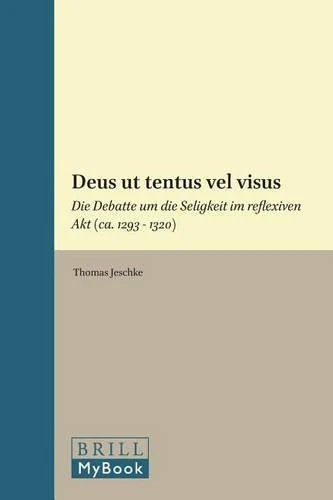
Deus ut tentus vel visus
In his Sentences Commentary (published ca. 1320), the Carmelite John Baconthorp discusses the question of whether beatitude is a reflexive act. He refers to John of Paris’s view in which beatitude is an act of knowing that we possess God and Durandus of St. Pourçain’s view that it is knowing that we know God. The object of the first is God as possessed (Deus ut tentus) and the second is God as known (Deus ut visus). Taking Baconthorp’s account as a starting point, the present study adopts a threefold approach: First it analyzes Baconthorp’s text on its own terms. Next it reconstructs the 13th/14th-century debate on the basis of the original sources. Finally it compares Baconthorp’s narration with the historical positions, drawing further conclusions about Baconthorp’s specific methodology.
In his Sentences Commentary (published ca. 1320), the Carmelite John Baconthorp discusses the question of whether beatitude is a reflexive act. He refers to John of Paris’s view in which beatitude is an act of knowing that we possess God and Durandus of St. Pourçain’s view that it is knowing that we know God. The object of the first is God as possessed (Deus ut tentus) and the second is God as known (Deus ut visus). Taking Baconthorp’s account as a starting point, the present study adopts a threefold approach: First it analyzes Baconthorp’s text on its own terms. Next it reconstructs the 13th/14th-century debate on the basis of the original sources. Finally it compares Baconthorp’s narration with the historical positions, drawing further conclusions about Baconthorp’s specific methodology.
$130.68
Original: $435.59
-70%Deus ut tentus vel visus—
$435.59
$130.68Description
In his Sentences Commentary (published ca. 1320), the Carmelite John Baconthorp discusses the question of whether beatitude is a reflexive act. He refers to John of Paris’s view in which beatitude is an act of knowing that we possess God and Durandus of St. Pourçain’s view that it is knowing that we know God. The object of the first is God as possessed (Deus ut tentus) and the second is God as known (Deus ut visus). Taking Baconthorp’s account as a starting point, the present study adopts a threefold approach: First it analyzes Baconthorp’s text on its own terms. Next it reconstructs the 13th/14th-century debate on the basis of the original sources. Finally it compares Baconthorp’s narration with the historical positions, drawing further conclusions about Baconthorp’s specific methodology.