🚚 Free Worldwide Shipping on All Orders!Shop Now

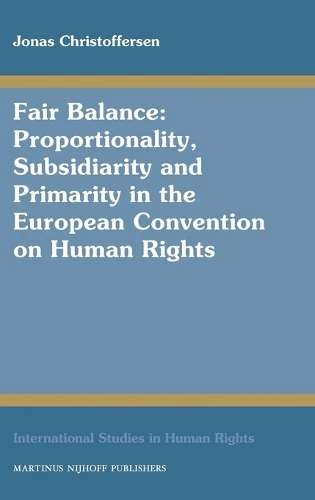
Fair Balance: Proportionality, Subsidiarity and Primarity in the European Convention on Human Rights
In one of the most important publications on the European Convention and Court of Human Rights in recent years, a wide range of fundamental practical and theoretical problems of crucial importance are addressed in an original and critical way bringing a fresh, coherent and innovative order into well-known battle zones. The analysis revolves around the Courta (TM)s fair balance-test and comprises in-depth analyses of e.g. methods of interpretation, proportionality, the least onerous means-test, the notion of absolute rights, subsidiarity, formal and substantive principles, evidentiary standards, proceduralisation of substantive rights etc. The author coins the term of a oeprimaritya in order to clarify the obligation of the Contracting Parties to implement the Convention in domestic law.
In one of the most important publications on the European Convention and Court of Human Rights in recent years, a wide range of fundamental practical and theoretical problems of crucial importance are addressed in an original and critical way bringing a fresh, coherent and innovative order into well-known battle zones. The analysis revolves around the Courta (TM)s fair balance-test and comprises in-depth analyses of e.g. methods of interpretation, proportionality, the least onerous means-test, the notion of absolute rights, subsidiarity, formal and substantive principles, evidentiary standards, proceduralisation of substantive rights etc. The author coins the term of a oeprimaritya in order to clarify the obligation of the Contracting Parties to implement the Convention in domestic law.
$394.69
Fair Balance: Proportionality, Subsidiarity and Primarity in the European Convention on Human Rights—
$394.69
Description
In one of the most important publications on the European Convention and Court of Human Rights in recent years, a wide range of fundamental practical and theoretical problems of crucial importance are addressed in an original and critical way bringing a fresh, coherent and innovative order into well-known battle zones. The analysis revolves around the Courta (TM)s fair balance-test and comprises in-depth analyses of e.g. methods of interpretation, proportionality, the least onerous means-test, the notion of absolute rights, subsidiarity, formal and substantive principles, evidentiary standards, proceduralisation of substantive rights etc. The author coins the term of a oeprimaritya in order to clarify the obligation of the Contracting Parties to implement the Convention in domestic law.