🚚 Free Worldwide Shipping on All Orders!Shop Now

Tonala
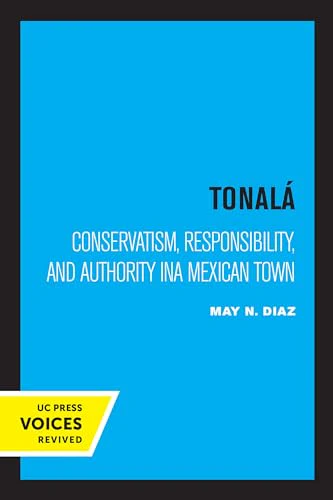
In this classic ethnography, May N. Díaz offers a richly textured portrait of Tonala, a pottery town on the outskirts of Guadalajara. Based on immersive fieldwork in 1959–60, the study explores how a seemingly conservative and traditional community negotiates the rapid industrial expansion of its nearby metropolis. Through vivid accounts of domestic life, kinship, marriage, and household economy, Díaz reveals how patterns of authority and responsibility are reproduced across generations, shaping Tonaltecan responses to modernization. The book illuminates both the resilience of village institutions and the subtle accommodations made to urban growth, wage labor, and state bureaucracy. Moving deftly from household interiors to the town plaza, Díaz situates Tonala within broader debates on industrialization and peasant society. Her analysis shows how familial hierarchies, gender roles, and neighborhood divisions underpin a worldview that favors continuity over innovation, while still engaging with markets, migration, and church politics. Tonala thus becomes a lens through which to understand the tensions between tradition and change in rural Mexico. Combining participant observation, local history, and meticulous census work, this book remains a benchmark for anthropological studies of community, authority, and cultural conservatism in Latin America. This title is part of UC Press's Voices Revived program, which commemorates University of California Press’s mission to seek out and cultivate the brightest minds and give them voice, reach, and impact. Drawing on a backlist dating to 1893, Voices Revived makes high-quality, peer-reviewed scholarship accessible once again using print-on-demand technology. This title was originally published in 1966.
In this classic ethnography, May N. Díaz offers a richly textured portrait of Tonala, a pottery town on the outskirts of Guadalajara. Based on immersive fieldwork in 1959–60, the study explores how a seemingly conservative and traditional community negotiates the rapid industrial expansion of its nearby metropolis. Through vivid accounts of domestic life, kinship, marriage, and household economy, Díaz reveals how patterns of authority and responsibility are reproduced across generations, shaping Tonaltecan responses to modernization. The book illuminates both the resilience of village institutions and the subtle accommodations made to urban growth, wage labor, and state bureaucracy. Moving deftly from household interiors to the town plaza, Díaz situates Tonala within broader debates on industrialization and peasant society. Her analysis shows how familial hierarchies, gender roles, and neighborhood divisions underpin a worldview that favors continuity over innovation, while still engaging with markets, migration, and church politics. Tonala thus becomes a lens through which to understand the tensions between tradition and change in rural Mexico. Combining participant observation, local history, and meticulous census work, this book remains a benchmark for anthropological studies of community, authority, and cultural conservatism in Latin America. This title is part of UC Press's Voices Revived program, which commemorates University of California Press’s mission to seek out and cultivate the brightest minds and give them voice, reach, and impact. Drawing on a backlist dating to 1893, Voices Revived makes high-quality, peer-reviewed scholarship accessible once again using print-on-demand technology. This title was originally published in 1966.
$51.19
Tonala—
$51.19
Description
In this classic ethnography, May N. Díaz offers a richly textured portrait of Tonala, a pottery town on the outskirts of Guadalajara. Based on immersive fieldwork in 1959–60, the study explores how a seemingly conservative and traditional community negotiates the rapid industrial expansion of its nearby metropolis. Through vivid accounts of domestic life, kinship, marriage, and household economy, Díaz reveals how patterns of authority and responsibility are reproduced across generations, shaping Tonaltecan responses to modernization. The book illuminates both the resilience of village institutions and the subtle accommodations made to urban growth, wage labor, and state bureaucracy. Moving deftly from household interiors to the town plaza, Díaz situates Tonala within broader debates on industrialization and peasant society. Her analysis shows how familial hierarchies, gender roles, and neighborhood divisions underpin a worldview that favors continuity over innovation, while still engaging with markets, migration, and church politics. Tonala thus becomes a lens through which to understand the tensions between tradition and change in rural Mexico. Combining participant observation, local history, and meticulous census work, this book remains a benchmark for anthropological studies of community, authority, and cultural conservatism in Latin America. This title is part of UC Press's Voices Revived program, which commemorates University of California Press’s mission to seek out and cultivate the brightest minds and give them voice, reach, and impact. Drawing on a backlist dating to 1893, Voices Revived makes high-quality, peer-reviewed scholarship accessible once again using print-on-demand technology. This title was originally published in 1966.